Browse

Log in / Register
 Share
Share
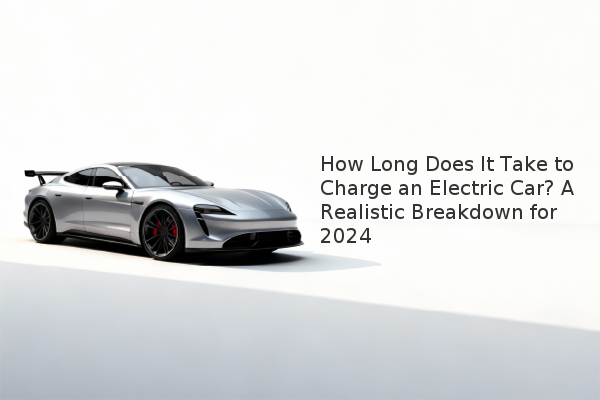
Charging an electric car can take anywhere from 20 minutes to over 40 hours, with the exact time depending on three key factors: the type of charger (Level 1, Level 2, or DC Fast Charging), your EV's battery capacity and maximum charging rate, and ambient temperature. For most owners, Level 2 home charging is the sweet spot, typically replenishing a battery overnight in 4 to 15 hours.
Before diving into times, it's essential to understand the three primary charging levels. Think of them as trickle charging, standard home charging, and highway-speed charging.
Level 1 charging is generally not feasible for regular use and should be considered a method of last resort. A standard household outlet delivers a maximum of about 5 miles of range per hour of charging.
Given that most modern EVs have a total range of at least 200 miles, a full charge from 0% to 100% would take a theoretical minimum of 40 hours. While it might work for plug-in hybrids with smaller batteries, for a full battery-electric vehicle (BEV), it's impractical for keeping up with daily driving needs. Based on our assessment experience, we strongly recommend that EV buyers invest in a Level 2 home charging setup for daily convenience.
Level 2 charging typically takes between 4 and 15 hours for a full charge, making it ideal for overnight use. The wide range exists because charging speed is determined by the vehicle's onboard charger and the power output of the Electric Vehicle Supply Equipment (EVSE)—the technical term for the wall-mounted "charger."
For example, in real-world tests:
The EPA provides official "time to charge" estimates on its vehicle specification pages. For instance, the EPA estimates a 2023 Tesla Model Y will take 9 hours and 24 minutes for a full Level 2 charge. By plugging in when you get home, your EV is almost always fully charged by morning.
Yes, but with important caveats. Public DC Fast Chargers can charge an EV from 10% to 80% in approximately 20 minutes to 1 hour. You'll notice manufacturers focus on the 10-80% range because DC fast charging slows down significantly after 80% to protect the battery's long-term health. Constantly charging to 100% on a DCFC can degrade the battery over time.
The speed varies greatly based on the charger's power (from 50 kW to 350 kW) and your car's maximum charging rate. We've charged a Hyundai Ioniq 5 from 18% to 80% in just 18 minutes on a 350-kW charger. However, colder temperatures can slow this process down considerably. This type of charging is best reserved for road trips, and modern EVs often have route planners that automatically schedule these stops.
The quoted times vary because charging speed isn't just about the plug. It's a complex interaction of several variables:
The key takeaway is that the vehicle itself is the primary governor of charging speed, not the charging equipment.
For optimal EV ownership, we recommend a combination of all three levels:
Ultimately, the best way to think about EV charging is not like filling a gas tank, but like charging your smartphone. You top it up overnight at home and use fast charging only when you really need a quick boost during the day.