Browse

Log in / Register
 Share
Share
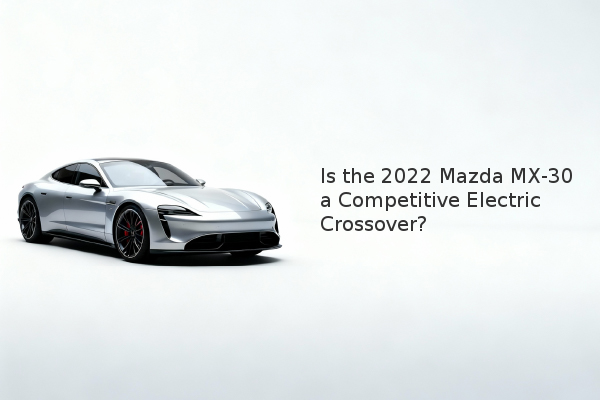
The 2022 Mazda MX-30 enters the electric vehicle market as Mazda's first EV for the U.S., but its standout design and premium interior are countered by a notably limited driving range that places it behind key rivals like the Hyundai Kona EV and Kia Niro EV.
Mazda has built a reputation on blending stylish design with engaging driving dynamics, but the brand has been a latecomer to the electric vehicle segment. The 2022 MX-30 is its answer, a battery-electric crossover that first debuted in 2019 and is slated for a limited U.S. release, starting in California. This analysis breaks down the MX-30's features, performance, and how it stacks up against the competition to help you decide if Mazda's first EV is the right choice.
The MX-30's styling is guided by Mazda’s Kodo 'Soul of Motion' design language, resulting in a sporty exterior with a coupe-like roof. A unique feature is its rear-hinged half-doors, which provide easier access to the rear seats but require the front doors to be opened first.
Inside, the cabin emphasizes sustainability with several eco-friendly materials:
The driver-centric cockpit features a floating center console with an electronic shifter and a 7-inch touchscreen for the infotainment system, aiming for a minimalist and modern feel.
Built on Mazda’s enhanced Skyactiv vehicle architecture, the MX-30 is a front-wheel-drive vehicle powered by an electric motor and a 35.5-kilowatt-hour (kWh) lithium-ion battery. For context, a kilowatt-hour (kWh) is the unit of energy that describes the total capacity of an electric car's battery pack.
This powertrain produces 144 horsepower and 200 pound-feet of torque. Mazda emphasizes a smooth ride and a connected driving experience, adhering to its philosophy of Jinba-ittai—a term meaning "the oneness of horse and rider." However, the most significant figure is its driving range. While the official EPA estimate for the U.S. model was not finalized at the time of writing, the European model is rated for a modest 124 miles on the European testing cycle. The EPA cycle often yields a slightly lower number, suggesting the U.S. range could be around 100 miles.
The battery can be charged to 80% capacity in approximately 36 minutes using a DC fast charger, which is a standard charging time for many EVs.
When placed side-by-side with competitors, the MX-30's specifications reveal a significant performance gap. The following table provides a clear comparison based on available data.
| Model | Horsepower | Torque (lb-ft) | Estimated Range (miles) |
|---|---|---|---|
| 2022 Mazda MX-30 | 144 | 200 | ~100-124 (est.) |
| Hyundai Kona Electric | 201 | 291 | 258 |
| Kia Niro EV | 201 | 291 | 239 |
| Volkswagen ID.4 | 201 | 229 | 250 |
As the data shows, the MX-30 falls short in horsepower, torque, and most critically, driving range. The Kona Electric and Niro EV offer nearly double the range, which is a primary consideration for most EV shoppers.
The MX-30 is just the first step in Mazda's electrification strategy. The automaker has announced plans for a plug-in hybrid MX-30 that will use a unique rotary engine as a generator to extend its range, as well as an all-new hybrid crossover for the U.S. market. This suggests that Mazda views the pure electric MX-30 as an introductory model while it develops more advanced electrified technology.
Based on our assessment of its specifications and features, the 2022 Mazda MX-30 presents a clear trade-off. It is likely best suited for a specific buyer:
However, for most shoppers seeking a versatile electric crossover, the MX-30's limited range makes it difficult to recommend over established rivals. The Hyundai Kona Electric, Kia Niro EV, and Volkswagen ID.4 offer significantly more range and power for a likely similar price, making them more practical for a wider range of driving needs. The MX-30's success will heavily depend on its final pricing and whether its distinctive style and interior craftsmanship can outweigh its EV limitations.