Browse

Log in / Register
 Share

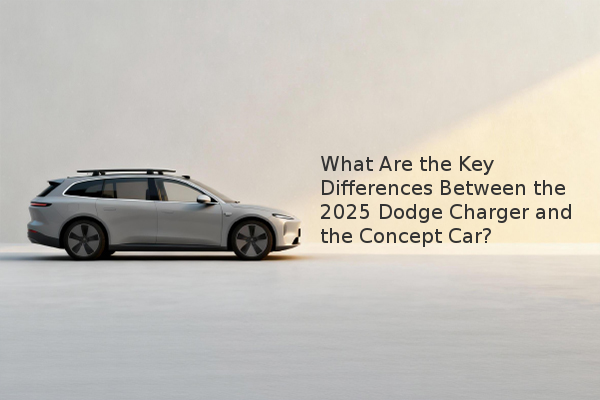
The 2025 Dodge Charger, set to launch in late 2024, enters its final testing phase with a pre-production model that reveals significant design changes from the radical 2022 Charger Daytona SRT Concept. While it retains the muscular essence, the production-ready model is narrower, features more conventional taillights and wheels, and will be offered with both electric and gasoline powertrains, signaling a pragmatic evolution of the American muscle car for a new era.
How Does the Rear Design Compare to the Concept? The most noticeable departure from the concept is at the rear. The pre-production 2025 Charger adopts a taillight design reminiscent of pre-2015 Charger models, with two square lighting elements separated by the trunk lid. This is a significant shift from the concept car's single, continuous loop of light, which offered a cleaner, more futuristic appearance. A third center-high-mounted stop light (CHMSL), absent on the show car, is also expected to be integrated near the roofline on the production model to meet federal safety regulations. This change highlights the transition from a design-focused concept to a street-legal vehicle.
What Changes Are Evident from the Front? Moving to the front, the similarities are more apparent. The pre-production car appears to carry over the concept's headlight design and features an illuminated "Fratzog" badge—a classic Dodge emblem—centered in the grille. However, the overall front fascia is notably narrower, bringing its proportions more in line with the recently discontinued ICE-powered Charger rather than the massively wide concept. This adjustment likely improves real-world drivability and aligns with manufacturing constraints. The presence of a charging or fuel door on the left rear quarter panel confirms Dodge's announcement that the production car will offer both all-electric (EV) and internal combustion engine (ICE) variants.
What Features from the Concept Are Likely for Production? Several of the concept's boldest features are likely to be tempered for production. The extravagant turbofan-style center-lock wheels have been replaced with more conventional all-black wheels on this test vehicle. While production versions may offer unique designs, center-locking mechanisms are typically reserved for ultra-high-performance exotics, not mass-market muscle cars. The concept's innovative R-Wing—a pass-through front aerodynamic element—may see a production version. Some hood sculpting is visible on the test car, and the absence of a large V-8 engine under the hood in EV models makes such aerodynamic features more feasible, even on gasoline versions.
While no interior images are available, based on our assessment experience, the cabin will likely be more practical than the concept's 2+2 layout with four bucket seats. Expect traditional seating for five, a less extreme use of ambient lighting, and a standard roof instead of a full-glass greenhouse. The new interior will represent a major technological leap over the outgoing Charger's dated cabin.
What Does This Mean for the Powertrain and Sound? Dodge has confirmed the production Charger will not be electric-only, a departure from the concept's pure-EV presentation. High-performance gasoline versions are expected, though they will likely use turbocharged six-cylinder engines instead of the traditional Hemi V-8. The fate of the concept's revolutionary Fratzonic Chambered Exhaust—a system that produces an artificial, 126-decibel exhaust note for the EV—remains one of the biggest unanswered questions. This pre-production model shows no visible exhaust tips, suggesting these images may be of an EV prototype. The final sound signature, whether an electric roar or a gasoline growl, will be a defining characteristic for muscle car purists.
The 2025 Dodge Charger is shaping up to be a balanced fusion of groundbreaking concept ideas and real-world production necessities. Key takeaways for enthusiasts are:
Official specifications, full reveals, and driving impressions are expected soon as the late-2024 launch approaches.