Browse

Log in / Register
 Share
Share
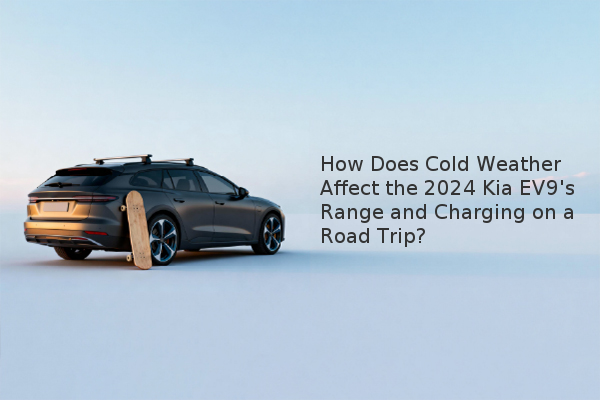
Based on our assessment experience, the 2024 Kia EV9 maintains sufficient range for long-distance winter travel, but subfreezing temperatures significantly impact efficiency and require meticulous trip planning, adding considerable time compared to a gas vehicle.
The core concern for any electric vehicle (EV) owner contemplating a winter road trip is range loss in cold weather. We put our long-term 2024 Kia EV9 to the test on a 600-mile round trip from Chicago to Detroit in subfreezing conditions. While the three-row SUV proved comfortable and capable, the journey highlighted the real-world challenges of cold-weather EV travel, including an observed efficiency of just 2.3-2.4 miles per kilowatt-hour (mi/kWh) and the absolute necessity of advanced planning using multiple apps. This firsthand account provides a clear picture of what to expect when driving an EV in winter.
The most significant impact of cold weather is on an EV's driving range. Lithium-ion batteries are less efficient in low temperatures, and energy is also diverted to heat the cabin and battery pack.
On this trip, the EV9's trip computer showed an average efficiency of 2.3 to 2.4 mi/kWh for most legs. This is a noticeable drop from the warmer-weather efficiency we've observed. For context, the EPA estimates a combined 89 MPGe for the EV9 Land trim, which equates to approximately 2.9 mi/kWh. The coldest leg saw efficiency drop to around 2.3 mi/kWh, while the final leg, with slower traffic speeds due to snow, improved to 2.8 mi/kWh.
The farthest distance traveled between DC fast-charging stops was 176.8 miles, which drained the battery from 90% to 11% state of charge. The other two legs were between 150-160 miles. All these segments were well below the EV9's EPA-estimated range of 280 miles and its estimated 250-mile maximum highway range, confirming that winter travel requires more frequent charging stops.
| Trip Leg | Distance Traveled | Starting Charge | Ending Charge | Approx. Efficiency |
|---|---|---|---|---|
| Leg 1 | 160 miles | 90% | ~20% | 2.3 mi/kWh |
| Leg 2 | 176.8 miles | 90% | 11% | 2.3 mi/kWh |
| Leg 3 | 150 miles | 90% | ~25% | 2.4 mi/kWh |
DC fast-charging is essential for long trips, allowing for rapid battery replenishment compared to Level 1 or 2 charging. We relied on the Electrify America (EA) network.
Charging speeds were generally good, but not without issues. At two 150-kW chargers, the EV9 charged at speeds up to 160 kW,接近 its maximum capability. At a more powerful 350-kW charger, it reached a peak of 197 kW. A key observation was the difference in charging behavior above an 80% state of charge. The 150-kW chargers allowed charging to 90% with only a gradual speed reduction, while the 350-kW charger slowed dramatically to around 5 kW at the 80% mark, effectively signaling the end of a useful fast-charging session.
Charging sessions lasted between 22 and 46 minutes, far longer than refueling a gasoline car. One session was plagued by a payment glitch that underreported the cost, which should have been approximately $43 instead of the $5.05 displayed. The total charging time added a significant, unavoidable delay to the journey.
A gasoline car trip requires little more than noting the distance. A winter EV trip demands a strategy. The EV9's native navigation system includes a trip-planner, but it was not helpful for filtering by a specific charging network.
A successful plan required a combination of tools:
This multi-app approach worked but was cumbersome. Having a single, robust planning feature within the vehicle's native system is a significant advantage that would streamline the process.
The EV9 itself is an excellent vehicle for a road trip. It is comfortable, quiet, and composed on the highway. However, the overall experience is defined by the charging ecosystem, not just the vehicle.
The need for more frequent stops, longer "refueling" times, and the dependency on sometimes unreliable public charging infrastructure made the trip more stressful and time-consuming than it would have been in a gasoline-powered SUV. While the upcoming access to Tesla's Supercharger network will improve convenience, the fundamental time penalty of charging remains.
For those considering a winter EV road trip, the key takeaways are:
While the 2024 Kia EV9 handled the winter conditions competently, the journey underscored that long-distance EV travel in cold weather remains a practice in patience and planning.